

Your arts and entertainment news from the U.S. Virgin Islands
Provided by AGP
Chinese documentary ‘Untethered Boat’ pays tribute to Su Dongpo’s moral strength
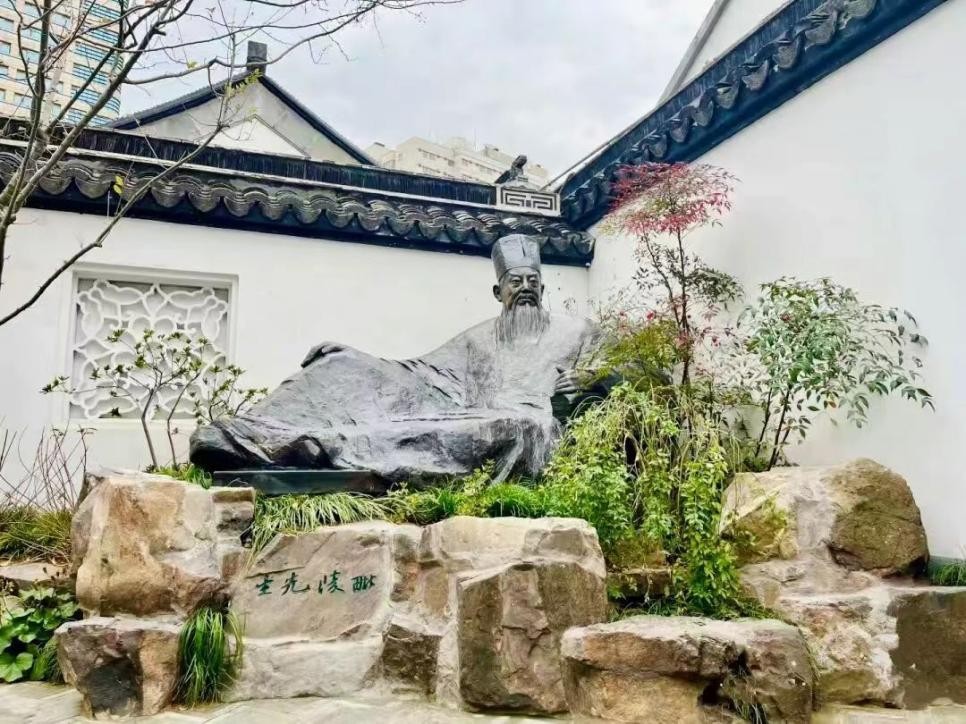
The Old Wisteria Hall – Where Su Dongpo spent his final days
CHANGZHOU, China, May 25, 2026 (GLOBE NEWSWIRE) -- A three-part humanistic documentary “Untethered Boat,” takes its cue from the life philosophy of Su Dongpo, also known as Su Shi, one of the most important cultural figures in Chinese history, that “the body is like a boat untethered.” This documentary was jointly produced by the Publicity Department of the Changzhou Committee of the Communist Party of China (CPC) and Zhejiang Media Group, and premiered on Zhejiang TV in December, 2025. Describing a spiritual journey about drifting and belonging, hardship and transcendence, the documentary invites audience to find inner peace and strength in Dongpo’s philosophy of life and has been hailed by some viewers as “a humanistic masterpiece with warmth, depth and feeling.”
Created together with the Changzhou Bureau of Culture, Radio, Television and Tourism, the Tianning District Committee of CPC Changzhou Committee, Changzhou Jinling Investment Group Co., Ltd., and the Zhenglu Township Committee of the Tianning District Committee of CPC Changzhou Committee, the documentary seeks to decode the contemporary relevance of Dongpo’s spirit.
Guided by Canadian cultural scholar Dashan, who traveled across more than 10 provinces and regions, the documentary moves beyond rigid historical narration and avoids any attempt to fashion a flawless sage, adopting the perspective of an equal dialogue while making Dongpo’s life feel vivid, tangible and deeply relatable.
Using his footsteps as a measure, it traces breadth of Dongpo’s life

The Yizhou Pavilion-Where Su Dongpo Came Ashore
From the formative influence of family values at the San Su Shrine in Meishan to the healing landscapes of West Lake in Hangzhou; from rebuilding himself amid hardship at Dongpo’s Snow Hall in Huangzhou to steadfast perseverance in the desperate circumstances of Huizhou and Danzhou, Dashan follows Dongpo’s life journey, touches the marks of China’s cultural heritage at historical sites and probes the spiritual core embedded in classical texts and historical records.
In Meishan, Dashan sees how the scholarly legacy of “three generations of father and sons” shaped Dongpo’s character. In Hangzhou, he feels the restorative power of nature and witnesses how Dongpo’s talent and compassion benefited the local people. In Huangzhou, Dashan comes to understand the self-reconciliation and renewal of life behind the name “Dongpo,” as well as the open-hearted resilience expressed in the line, “Let mist and rain drench me all my life.”
Across three closely linked episodes, themed of “setting sail, losing the way, and returning home,” the documentary charts Su Shi’s full life journey, from youthful ambition and middle-age adversity to serenity in old age. The third episode, “The Returning Boat,” focuses on Dongpo’s wandering final years and homeward path, becoming the spiritual high point of the entire documentary. In his sixties, he was exiled to Danzhou on Hainan, then a remote and impoverished place, yet this harsh environment could not confine the growth of his spirit. He promoted education, wrote extensively, cultivated the cultural life of the region and transformed local society. In the bleakest circumstances, he remained true to his original ideals, and through hardship attained spiritual transcendence, embodying through action a life philosophy of finding renewal in the face of death.
“My heart is like dead ashes, my body like a boat untethered. If you ask about the achievements of my life — Huangzhou, Huizhou, Danzhou.” This self-inscribed poem from Su Shi’s later years captures both the drifting and clarity of his life. Tianning in Changzhou was the final spiritual harbor where this “untethered boat” came to rest — the poetic homecoming for a man who had wandered for half a lifetime.
In the documentary, Dashan makes a special trip to Tianning in Changzhou, following the flow of the ancient Grand Canal, pausing at Yizhou Pavilion and visiting the old Wisteria Hall, gazing across a millennium toward Dongpo. Beneath Yizhou Pavilion lingers the loneliness and compassion of the New Year’s Eve in 1074, when Dongpo spent the night outside the city walls.
His verse, “My thanks to the dying lamp for not spurning a traveler; all night long it let my lonely boat draw near,” contains the earliest bond between him and Changzhou. At the old Wisteria Hall, the white walls and grey tiles still preserve the warmth of the last 40-odd days of his life. According to legend, he planted a wisteria vine there with his own hands. Returning to Changzhou in old age, he settled his body and spirit there and remained until the end of his life.
Changzhou was a place Dongpo visited 14 times and never ceased to cherish. It was where he twice submitted memorials asking to live, and the “place where this heart can rest” that he longed for on his deathbed. The documentary offers a profound interpretation: Dongpo’s wish to “grow old in Changzhou” was never simply the end point of his life, but a gentle resolution to a lifetime of drifting. After half a life of upheaval, he finally found his place of return. This sense of ease — of drifting with the current, free to go east or west — is a vivid expression of Eastern wisdom about life.
The documentary innovatively adopts a progressive narrative structure of “circumstance, state of mind, and poetic realm,” blending poetry recitation, AI-generated imagery, light-and-shadow art and symphonic music to breathe new life into Dongpo’s poetry in the digital age and make a thousand years of cultural heritage palpable. Rather than piling up historical facts or speaking in empty abstractions, it uses Dashan’s journey of discovery, nuanced visual language and moving emotional resonance to show how Su Shi, under the repeated blows of fate, found freedom amid rootlessness, cultivated equanimity amid adversity, and achieved both inner repose and spiritual transcendence.
Since its release, the documentary has received high praise and widespread acclaim, which some Chinese audiences hailed as “a humanistic masterpiece with warmth, depth and feeling.”
Industry commentators said it breaks out of the rigid mold of traditional humanistic documentaries, interpreting traditional Chinese culture through an international lens while combining historical depth with contemporary resonance.
Some audiences have praised its gentle, restrained storytelling and its evocative imagery, saying it not only restores a real and multidimensional Su Shi but also transforms thousand-year-old philosophical reflection into a healing force that speaks directly to the heart.
Some reviewers have gone so far as to say that the documentary is not merely a look back at Dongpo’s life, but a cross-border cultural dialogue and a spiritual resonance that reaches people deeply, offering an outstanding model for the creation of contemporary humanistic documentaries.
This life wisdom spanning a thousand years is precisely the kind of healing remedy many people need today. “Untethered Boat” tells every viewer: life is like a boat, and drifting is inevitable, but as long as one remains clear-minded and true to one’s heart, every place can become a place of return.
Pls see the whole documentary here: https://youtu.be/U46w-swaVH4
Company:Publicity Department of the Changzhou Committee of the Communist Party of China (CPC)
Contact Person: Ning Chen
Email:tndzzwzx@163.com
Website:https://www.cztn.gov.cn/
Telephone:0519-69660318
City: Chang Zhou
Photos accompanying this announcement are available at:
https://www.globenewswire.com/NewsRoom/AttachmentNg/dd92c045-eccf-4367-a5e5-7aadf662bc51
https://www.globenewswire.com/NewsRoom/AttachmentNg/a813bd0c-a31a-4193-b169-0b93a4a48c48

The Old Wisteria Hall – Where Su Dongpo spent his final days
The Old Wisteria Hall – Where Su Dongpo spent his final days
The Yizhou Pavilion-Where Su Dongpo Came Ashore

The Yizhou Pavilion-Where Su Dongpo Came Ashore
Legal Disclaimer:
EIN Presswire provides this news content "as is" without warranty of any kind. We do not accept any responsibility or liability for the accuracy, content, images, videos, licenses, completeness, legality, or reliability of the information contained in this article. If you have any complaints or copyright issues related to this article, kindly contact the author above.
